

Have you ever watched a fish follow your lure but not bite?
It's one of the most frustrating experiences in lure fishing. You’ve chosen the right spot, matched the hatch, and presented your lure perfectly—yet the fish refuses to commit.
So why do fish follow lures but not bite?
The answer often comes down to one overlooked factor: lure scent.
Understanding how fish use their sense of smell can help you convert more follows into strikes, more strikes into hook-ups, and ultimately more fish into the net.
Why Scent Matters in Lure Fishing
Many anglers have heard the claim:
"Fish don't care about scent."
But if that were true, why do fish rely so heavily on smell to locate food in the wild?
Fish live in a completely different sensory world than humans. While we depend primarily on sight, fish use a combination of:
- Sight
- Vibration
- Sound
- Water pressure changes
- Smell (olfaction)
In many fishing situations, scent can be the deciding factor between a fish investigating your lure and actually eating it.
Whether you're targeting bream, flathead, snapper, mulloway, whiting, bass, or estuary perch, understanding the role of scent can significantly improve your lure fishing success.
How Fish Use Their Sense of Smell
Most Australian sportfish species have an incredibly advanced sense of smell.
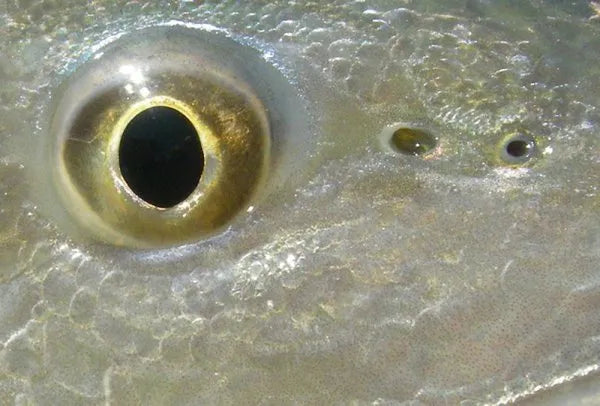
Fish detect chemical signals in the water through specialised nostrils called nares, which are designed specifically for smelling rather than breathing.
As water flows through these sensory organs, fish can detect tiny concentrations of:
- Amino acids
- Natural oils
- Food compounds
- Biological scents released by prey
These are the same chemical cues produced by prawns, baitfish, crabs, worms, and other natural food sources.
This is why fish can locate food in:
- Dirty or stained water
- Deep water
- Low-light conditions
- Night-time feeding periods
In many cases, fish are literally following scent trails to find their next meal.
Why Fish Follow Your Lure But Don’t Strike
If you've spent any time fishing soft plastics or hard-bodied lures, you've probably experienced this scenario:
- Fish appear on your sounder.
- You watch them on LiveScope.
- You feel bumps and nudges.
- Fish follow your lure repeatedly.
Yet they refuse to bite.
Why?
Because while many lures look like food, they often don't smell or taste like food.
A fish may be curious enough to investigate your lure, but when it gets close, something feels unnatural.
The visual presentation attracts attention, but the lack of natural scent can prevent the fish from fully committing.
This is where fishing scent can make a significant difference.
How Lure Scent Helps Trigger More Bites
Think of scent as the final trigger in the feeding process.
Your lure's:
- Action attracts attention.
- Colour creates visibility.
- Presentation generates interest.
But scent helps convince the fish that what it's seeing is actually worth eating.
When fish detect familiar food-related compounds coming from a lure, it can increase their confidence and encourage them to strike.
This can be particularly effective when:
- Fish are heavily pressured
- Water clarity is poor
- Fish are feeding cautiously
- Water temperatures are cold
- Fish are following but not committing
- Fishing pressure is high
Many anglers report more aggressive bites and fewer tentative taps after incorporating quality lure scents into their fishing routine.
Does Fishing Scent Actually Attract Fish?
One of the biggest misconceptions about fishing scents is that their only purpose is attracting fish from long distances.
While scent can certainly help fish locate your lure, its greatest advantage often occurs after the fish makes contact.
Fish frequently strike a lure and instantly realise it isn't real.
When that happens, they can spit it out in a fraction of a second.
A quality fishing scent helps create a more natural taste profile, encouraging fish to hold onto the lure longer.
That extra second can be critical.
It gives anglers more time to:
- Detect subtle bites
- React to strikes
- Set the hook effectively
- Improve hook-up rates
This is why many lure anglers notice better conversion rates even when the total number of bites remains similar.
Why We Developed STRIKERZ Lure Scents
At STRIKERZ, we set out to create a lure scent specifically designed for Australian fishing conditions and Australian fish species.
We wanted something that:
- Clings effectively to soft plastics and hard-bodied lures
- Doesn't wash off after a few casts
- Isn't excessively oily or messy
- Performs in both saltwater and freshwater environments
- Delivers a natural food signal fish recognise
Our emulsion-based formula is designed to stay on your lure longer while helping create a realistic scent trail in the water.
Whether you're:
- Chasing bream around oyster racks
- Working shallow flats for flathead
- Fishing plastics over snapper reefs
- Targeting mulloway in estuaries
- Casting for bass in freshwater systems
The goal remains the same:
Give fish one more reason to eat your lure.
The Bottom Line: Can Lure Scent Help You Catch More Fish?
Successful fishing is often about stacking small advantages in your favour.
The right:
- Tide
- Location
- Lure
- Retrieve
- Presentation
All contribute to success.
Adding scent is simply another way to improve your odds.
Will fishing scent magically make fish appear where none exist?
No.
But if it helps convert:
- More follows into strikes
- More strikes into hook-ups
- More hook-ups into landed fish
Then it's a simple addition that can deliver real results.
And when fishing can be decided by a single bite, sometimes that's all the advantage you need.
Ready to Turn More Follows Into Bites?
Discover the STRIKERZ range of Australian-made lure scents and see why more anglers are adding scent to their lure fishing arsenal.
Because sometimes the difference between a follow and a fish is simply giving it a reason to commit.


