

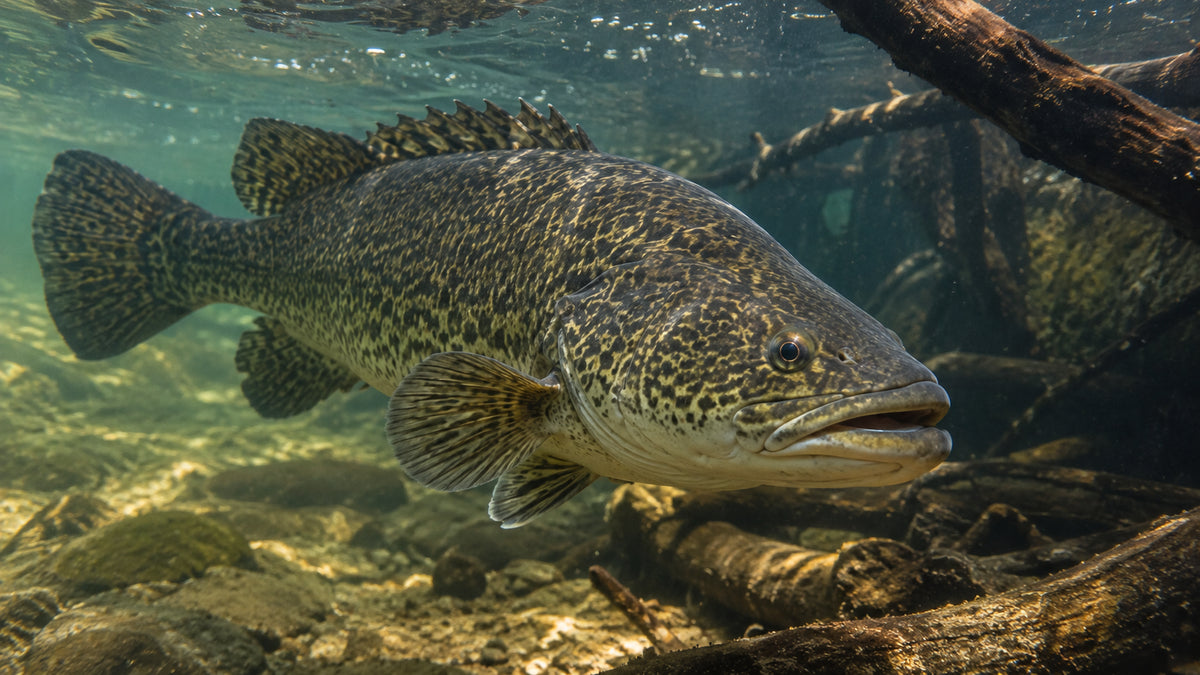
There’s something different about chasing Murray cod.
You can spend hours casting without seeing a fish, start wondering whether there’s even a cod in the area, and then one cast changes everything. A lure gets absolutely smashed beside a log, the rod loads up and suddenly you’re trying to stop a big green fish from burying you back into the timber, That’s cod fishing.
One of the biggest things with Murray cod is understanding that you’re not necessarily trying to make a fish chase your lure halfway across the river. A lot of the time you’re trying to put that lure right into the fish’s territory and give it a reason to attack, and that means fishing structure.
Find the Right Water
Whether fishing a river or an impoundment, the first thing you should be looking for is somewhere that gives a cod a good ambush point.
Fallen timber is the obvious one, but don’t become so focused on logs that you ignore everything else.
Rock walls, boulders, undercut banks, drop-offs, creek channels, standing timber and deeper holes can all hold fish.
Look at a spot and ask yourself, If I was a cod, where would I sit?
You’re looking for somewhere a fish can stay protected and comfortable while having easy access to food.
In rivers, that might be the downstream side of a big log or rock where the fish can sit out of the main current.
In dams, it might be a rocky point dropping into deeper water, an old creek bed or a line of submerged timber.
Once you start looking at the water that way, you stop randomly casting and start actually targeting fish.
Get Your Lure Tight to Structure
This is probably one of the biggest differences between anglers who regularly catch cod and anglers who struggle.
You need to get your lure in there.
If there's a big log sitting along the bank and your lure lands three metres away from it, you might have already missed the best part of the cast, you want that lure landing tight, sometimes ridiculously tight.
You're going to get snagged. You're probably going to lose a few lures. That's part of cod fishing.
But I'd rather lose the occasional lure putting it where the fish are than spend the entire day casting into safe water.
Casting accuracy is something worth practising. The difference between putting a lure beside a log and putting it right beside the log can be the difference between getting belted and getting nothing.
Spinnerbaits
Spinnerbaits would have to be one of the best all-round Murray cod lures ever made.
They're relatively snag resistant, they put out plenty of vibration and you can fish them at almost any depth, around heavy timber they're hard to beat.
Generally speaking, cast as tight as possible to the structure, let the spinnerbait sink to the depth you want and then start a slow retrieve. You don't need to burn it back.
As long as the blades are working, let that lure spend as much time as possible around the structure.
If you are fishing deeper water, let it sink further before starting the retrieve.
If it bumps into timber, pause it briefly and then get it moving again.
That change in speed and direction can be enough to trigger a fish.
Hardbodies
Hardbody lures are another absolute cod staple.
One thing I think some anglers are frightened of doing is actually hitting structure with them, I want my hardbody getting down and working. If it bangs into a log or deflects off a rock, that's not necessarily a bad thing, in fact, that's often when you get eaten.
If I'm fishing a floating hardbody and feel it hit timber, I'll sometimes stop winding and allow the lure to start floating backwards away from the snag, Then I'll start the retrieve again.
You've suddenly made that lure look like something that has hit an obstacle, stopped and changed direction.
That's exactly the sort of thing that can trigger a reaction strike.
Swimbaits and Big Soft Plastics
Swimbaits have become a massive part of Murray cod fishing, particularly when targeting bigger fish.
But there's one mistake I see with big lures, People assume because the lure is big, you need to fish it aggressively. You don't.
Some of the best presentations are painfully slow, A big swimbait slowly rolling past a log or along a rocky point looks like an easy meal.
Change the retrieve until you find what the fish want.
- Slow roll.
- Pause.
- Let it sink.
- Start again.
Sometimes I'll deliberately stop a swimbait beside structure and let it hang or sink before getting it moving again.
A cod might have followed that lure several metres without committing, that pause can be what finally makes it eat.
Surface Fishing
Then there's surface fishing.
If you've never had a Murray cod smash a surface lure, put it on the list, There's nothing quite like it.
You're slowly winding a lure through the darkness and suddenly: BOOF!
The whole surface explodes, Your natural reaction is to strike immediately. Try not to.
Wait until you actually feel the weight of the fish.
Cod can miss surface lures completely and if you rip the lure away immediately, you've potentially taken away your second chance.
If the fish misses, keep the lure moving, it might come back.
I'll generally concentrate surface fishing around low-light periods and into the night, particularly around shallow structure, rocky edges, timber and flats close to deeper water.
And again, don't be frightened to fish slowly, Give the fish time to find the lure and don't forget the pause
One of the simplest things you can do when lure fishing for cod is stop winding, it sounds almost too simple but think about what happens.
- A hardbody starts floating.
- A soft plastic starts sinking.
- A spinnerbait flutters.
- A swimbait stops swimming and hangs there.
You've suddenly changed the entire presentation.
If a cod has been following your lure trying to decide whether it's worth eating, that change can be enough to trigger it.
Don't make every cast identical, Experiment. Rivers and Dams Need Different Approaches
When fishing a river, look at individual pieces of structure.
- A particular log.
- A root system.
- A rock.
- An undercut bank.
- A deep hole.
You're picking the river apart.
In a big dam, think much bigger.
Instead of immediately looking for one particular log, look for the area first.
- Where's the old river channel?
- Where's the drop-off?
- Where does a rocky point extend underwater?
- Where's the standing timber?
- Where does shallow water meet deep water?
Once you find an area that looks right, then start picking apart the individual pieces of structure within it.
Fish Different Depths
If you're confident there's fish in an area but you're not getting touched, don't immediately leave.
Change your depth, this is something that can make a massive difference.
You might have two anglers casting at exactly the same log, but one is fishing one metre below the surface while the other is fishing four metres down.
They're effectively fishing two completely different spots.
Work through the water column.
- Shallow.
- Mid-water.
- Deep.
- Sometimes right along the bottom.
Finding the depth the fish are holding at can completely change your day.
What Gear?
I'm not a fan of going unnecessarily light when targeting Murray cod.
You're deliberately casting around timber, rocks and some seriously nasty country.
If a decent cod eats your lure beside a submerged tree, you want enough power to turn its head.
Match your rod and reel to the size of lures you're throwing and use quality braid and a strong abrasion-resistant leader.
But don't just concentrate on your line.
Check everything.
- Leader knots.
- Split rings.
- Hooks.
- Snaps.
- Connections.
The weakest part of your setup is what will eventually let you down.
And you don't want to discover what that is when you've finally hooked the fish you've been casting for all day.
If You Get a Hit – Cast Back
This is a big one, If a cod hits your lure and misses it, get another cast straight back in there.
Don't assume you've blown your chance, that fish has just shown you exactly where it is.
If it misses a surface lure, I'll generally throw it back again.
If it won't come back for the surface lure, I might follow it up with something subsurface.
- A swimbait.
- Spinnerbait.
- Hardbody.
- Something different.
The fish has already shown some aggression, give it another opportunity.
Adding Scent
Obviously we're big believers in scent at STRIKERZ, but I don't look at scent as something that makes up for bad fishing.
- You've still got to find the fish.
- You've still got to make the cast.
- And you've still got to put the lure in the strike zone.
What scent does is add another part to the presentation.
You've already got the profile of the lure, its movement, vibration and colour.
Adding STRIKERZ Pro Scent gives you another element working for you.
I particularly like the idea of scent when you're fishing slowly around structure.
If you're crawling a soft plastic or swimbait past a log and keeping it in that strike zone for as long as possible, I want every part of that presentation working.
It's not about replacing good technique, It's about stacking as many things in your favour as possible.
Don't Give Up on Good Water
This is probably the biggest thing with cod fishing, Persistence.
Murray cod can make you question everything you're doing, you can fish what looks like perfect water for hours without getting touched, then suddenly someone gets smoked.
If an area looks right, don't necessarily give up on it.
- Change lure.
- Change colour.
- Change depth.
- Change retrieve speed.
- Come back later.
- Fish it at sunset.
- Fish it after dark.
Sometimes the fish was there the entire time, it simply wasn't ready to eat.
That's why cod fishing gets under your skin.
Every cast feels like it could be the one.
Look After Them
Murray cod are too good a fish not to look after.
Have your landing gear ready before you start fishing, particularly if you're specifically chasing bigger fish.
If you're taking a photo, have everything organised so you can get the fish back into the water quickly.
Support the fish properly and minimise the amount of time it's out of the water.
And most importantly, always check the current regulations for the particular state and waterway you're fishing, including closed seasons, size limits and possession limits.
One More Cast
That's probably the phrase that sums up Murray cod fishing better than anything.
One more cast.
- You've been throwing lures for six hours.
- Your shoulder hurts.
- You've changed lures ten times.
Nothing.
Then you look at one last log sitting in the water.
- Perfect angle.
- Bit of depth underneath it.
You put the lure tight against the timber, two winds of the reel.
Bang.
That's Murray cod fishing.
- Find good water.
- Fish tight to structure.
- Slow your presentation down.
- Experiment with depth.
- Don't be frightened to lose a lure.
- And above everything else, keep casting.
Because the next one really could be the cast you've been waiting for.
See you on the water.
STRIKERZ


